Environmental footprint of AI
As AI models grow in complexity and scale, their energy consumption and carbon emissions become increasingly significant. Monitoring the environmental footprint of AI workloads is essential to promote sustainable practices and to make informed decisions about resource usage during training and inference.
This is why AI4EOSC has teamed with Wattnet and the Greendigit project to monitor the energy footprint of the platform and to act upon it. What is this integration currently offering?
Real-time footprint visualization
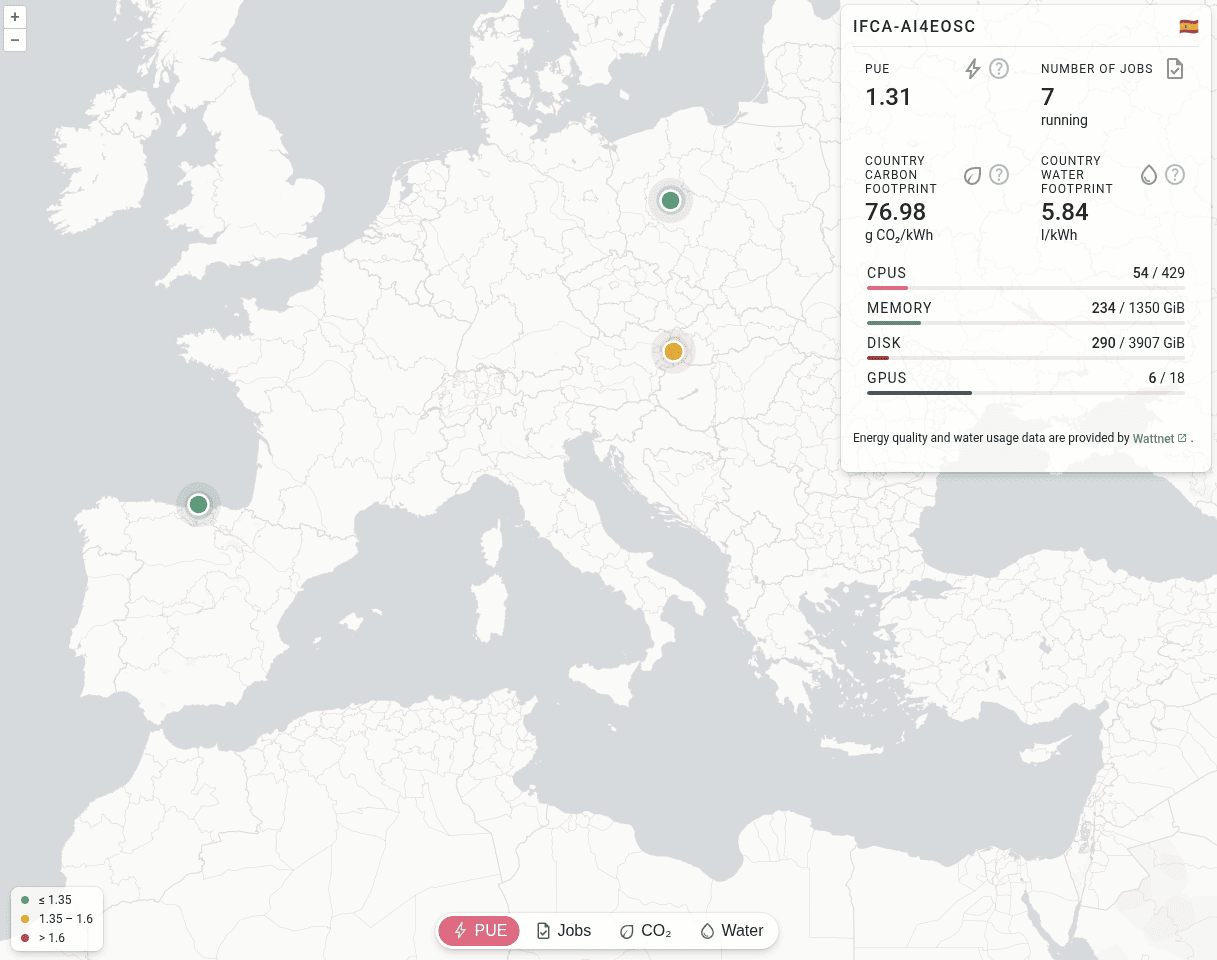
The Dashboard statistics integrates a map with all the datacenters that are part of the AI4EOSC federation. Wattnet is able to offer real-time time estimations of the impact of each datacenter, based on the mean values of the country where the datacenter is located. It offer both a carbon footprint (measured in gCO2/kWH) and a water footprint (measured in l/kWH). Lower values for both metrics will mean that the datacenter energy is cleaner.
Smart job scheduling
Power Usage Effectiveness (PUE) is a metric that measures the energy efficiency of a datacenter by comparing the total energy consumed by the facility to the energy delivered to the computing equipment. A PUE of 1.0 would mean all energy goes to computing, while higher values indicate more energy is spent on cooling, lighting, and other overhead.
At the WMS level, we have implemented the AI4EOSC GreenDirector, a green-aware extension that ranks candidate sites based on environmental metrics (e.g. PUE, carbon intensity, and water usage) obtained through the GreenDIGIT metrics publication system (EIMPS). This allows us to introduce energy-aware scheduling, where the platform favors routing new deployments to greener datacenters via Nomad affinities.
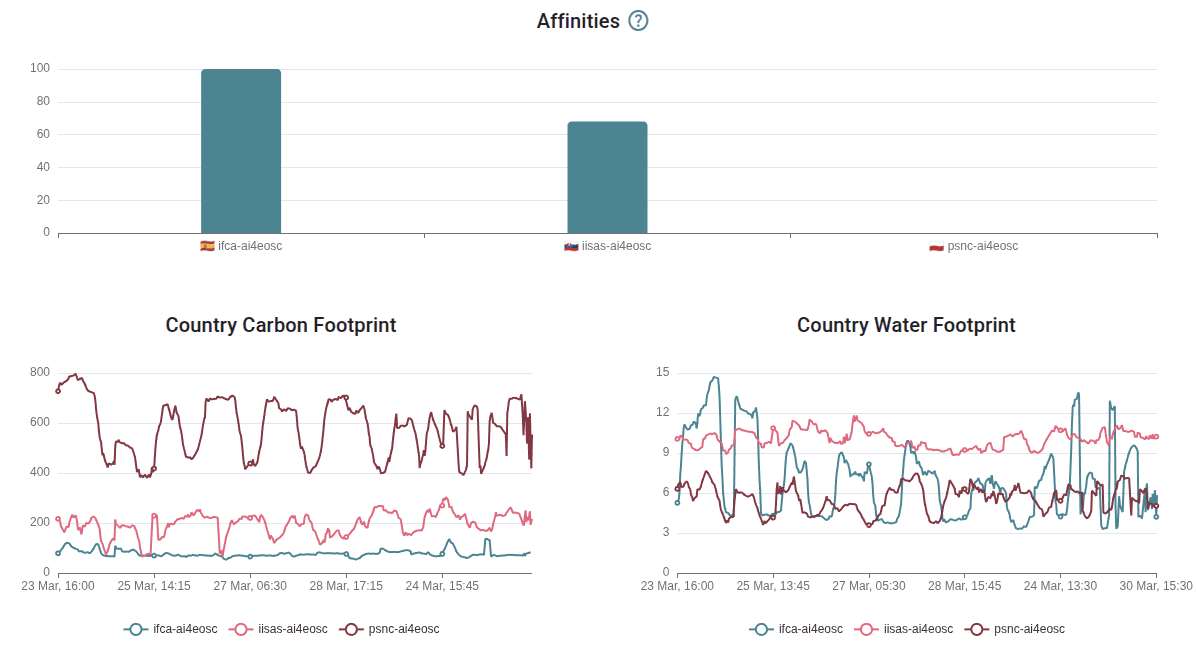
Future iterations will go even further, leveraging Wattnet forecasting capabilities to schedule jobs during the particular hours of the day where energy is greener.
Detailed per-job monitoring
Beta
This feature is still in development and may be subject to changes.
Finally, AI4EOSC leverages the Greendigit stack (based on Scaphandre) to offer realtime energy consumption metrics of any particular deployment in the AI4EOSC platform. Then Wattnet is used to transform this measurement into a relatable carbon footprint, that is shown to the deployment owner in the Dashboard.
Finally, this information is included in the provenance chain of the AI module, offering future users accurate information of what was the training footprint of that particular module.
By providing this level of transparency, AI4EOSC aims to raise awareness among users about the environmental cost of their AI workloads. Making researchers and developers mindful of the resources they consume encourages more responsible usage patterns, such as optimizing model architectures or reducing unnecessary training runs.